

Countryside Adventurous Tours
The vast majorities of Cambodian people live and work in small villages in the countryside. Exploring the modern opportunities in Siem Reap and the ancient spectacles of the temples are fantastic opportunities, but to fully explore Khmer culture and the struggles that Cambodia continues to face, a trip to the countryside is essential. Cambodia is the poorest country in Southeast Asia and Siem Reap province remains the second poorest province in the country. Countryside tour or even a day trip to a remote temple ruin can provide a glimpse of ‘real Cambodia’ - picturesque, bucolic scenery, rice paddies and water buffaloes, countryside pagodas and little villages filled with traditional stilted houses Tonle Sap Lake Adventurous tours
The 'bird sanctuary' at the Prek Toal core area of the Tonle Sap Biosphere Reserve has been called "the single most important breeding ground in Southeast Asia for globally threatened large waterbirds." The Biosphere covers 31,282 hectares at the northwest tip of the Tonle Sap Lake and plays host to species including Greater and Lesser Adjuncts, Black-headed Ibis, Painted Stork, Milky Stork, Spot-billed Pelican, Grey-Headed Fish Eagle and many more species. Of the three Biosphere core areas on the Tonle Sap Lake, Prek Toal is the most accessible from Siem Reap and the most popular with birdwatchers. The best time of year for viewing is the dry season when flocks of migratory birds congregate at Prek Toal. As the dry season progresses and the water recedes, the number of birds increases but the travel to some of the more important viewing areas becomes more difficult.
Kampong Phluk sees comparatively few foreign visitors and offers a close look at the submerged forest and lakeside village life as yet unperturbed by tourism. The area can be reached by boat from the Chong Khneas or by a combination of road and boat.
The area can be reached by boat from the Chong Khneas docks or by a combination of road to Domdek on Route #6 and then boat to the village, the best method depending on the time of year. During the dry season, boats cannot get all of the way to the main villages. Temples Adventurous tours
Visiting Kbal Spean can be included in visiting Banteay Srei and Kulen Mountain or Beng Mealea
Visiting Kulen Mountain can be included in visiting Banteay Srei and Beng Mealea or Kbal Spean
Built in the 12th Century, many scholars believe it was the model for Angkor Wat. It is just as wonderful of a temple but it is still largely lost in the jungle. The accommodations made for tourists at Angkor Wat and Angkor Thom have not been made here, and visitors enjoy a much quieter and adventurous experience. Visiting Beng Mealea can be included in visiting Roulous Group and Banteay Srei or Banteay Srei and Kbal Spean or Banteay Srei and Kulen Mountain
The Koh Ker site is dominated by Prasat Thom, a 30 meter tall temple mountain raising high above the plain and the surrounding forest. Great views await the visitor at the end of an adventurous climb. Garuda, carved into the stone blocks, still guard the very top, although they are partially covered now. Across the site of Koh Ker there are many prasat or tower sanctuaries. A couple still feature an enormous linga on a yoni that provides space for several people. The outlet for the water that was sanctified by running it over the Linga can be seen in the outside wall of one of them. In other cases, three prasat stand next to each other, dedicated to Brahma, Shiva and Vishnu. Most of them are surrounded by libraries and enclosures, many also had moats. At that time, the roofs were still made of wood. Today, only the holes for the beams remain in the stone structures. Visiting Koh Ker Group can be included in visiting Roulous Group, Beng Mealea and Banteay Srei
Affording a view for many kilometers across a plain, Prasat Preah Vihear has the most spectacular setting of all the temples built during the six-centuries-long Khmer Empire. As a key edifice of the empire's spiritual life, it was supported and modified by successive kings and so bears elements of several architectural styles. Preah Vihear is unusual among Khmer temples in being constructed along a long north-south axis, rather than having the conventional rectangular plan with orientation toward the east. The temple gives its name to Cambodia's Preah Vihear province, in which it is now located, as well as the Khao Phra Wihan National Park which borders it in Thailand's Sisaket province and through which the temple is most easily accessible. On July 7, 2008, Preah Vihear was listed as a UNESCO World Heritage Site.
Visiting Sambo Prei Kuk can be included in visiting Kampong Thom City of Kampong Thom province
It's about 170km from Siem Reap city and driving is very scenic, winding through farms and poor hamlets of Khmer, many of whom have never travelled outside of their small communities or to a city. Visitors must travel from Siem Reap by Car.
| |||||||||||||||||||||||||||||||||||||

Showing posts with label Angkor Wat. Show all posts
Showing posts with label Angkor Wat. Show all posts
Adventurous Tours


Cambodian Tragedy in Comparative Term
 |
| The Strongman shedding crocodile tears? (Photo: AP) |
For the very first time that the entire world and the Cambodian public at large got to witness a Cambodian Prime Minister cried – something they’re rarely used to seeing on screen, given his past combative speeches and authoritarian style. I’ve got to give it to the man. He gave one of the finest theatrical shows I have ever seen - weeping and looking sad as best as he can be. But, NOT when he evicted Khmers from their lands; put Khmer farmers in jail; ordered his men to launch a couple grenades against political opposition march, lining up people to shoot as a result of his 1997 coup d’état. He was not crying when he sent capable men on K5 plan to be killed or limped. NO
Unfortunately when we are talking about our Cambodia, this is not the first tragedy or policy failure and it won’t be the last, either, that we are going to see from this government, going forward. There have been too many policy failures in the past and present leading up to the future. Time will tell if the true believers of the Hun’s regime, and possibly dynasty, will learn something meaningful at the end; for a nation built on shaky foundations where the culture of impunity, corruption and feudalistic behaviour are accepted as the norms at the expenses of the mass - the poor and the very least educated farmers. More land evictions are on the horizon, watch my word, people.
It is truly refreshing, yet not surprising to see Cambodian come out in large numbers to offer money and condolences to the victims and surviving families. In comparative analysis, it makes you wondered, what about other tragedies? Take land eviction as a prime example where entire villages are affected or the beating, killing of democratic activists, union leader, singers etc..? The story of Mr. Soung Sophorn is relatively fresh. Isn’t it a tragedy as well?. He was beaten up pretty badly and unprovoked at best – something could have been easily avoided. The Cambodian polices were better trained to hurt Khmers, protect Youn’s encroached farmer’s lands than to save real Cambodian lives. How sad!
My 2-cent engineering perspective on the Pich Bridge tragedy
 |
| Koh Pich suspension bridge (Photo; AFP/Xinhua) |
In view of the recent tragedy on Koh Pich Bridge where several hundreds of our compatriots died and were seriously injured, I would like to provide below, my personal perspective as a Civil engineer in this regards. While my specialty is not in Structural engineering, but rather in Geotechnical engineering, i.e. a specialty related to foundation engineering etc, I will strive to explain as best as I can, in laymen terms, the various aspects of bridge construction, and in particular the suspension bridge type that is used for Pich Bridge linking mainland to Koh Pich Island, and I will also provide my 2-cent input on the various aspects any investigation should consider.

The most basic method of constructing a bridge can be seen in the illustration above. First several piers are constructed as support for the bridge, next a bridge deck is placed in between two piers to provide a platform on which traffic can move over the bridge. In general, guard rails will be constructed next to prevent vehicles and foot passengers from falling off the bridge. While in concept, this construction method appears quite simple, the reality is not so. For one thing, if the spacing between two consecutive piers is very wide, then the bridge deck need to be designed thicker or more rigid so that when traffic moves over the bridge, there would be not too much vertical deflection (see black arrow in the illustration above).


Who’s responsible for the Koh Pich accident?
 |
| Who's responsible: Maybe you are looking at him right now? (Photo: AP) |
Radio Free Asia
Translated from Khmer by Soch
Government officials indicated on 27 Nov that, up to now, the tally of the number of dead and injured people inside the hospitals shows that there are 347 deceased and 395 injured. This number is lower than a previous tally which put the total number of dead and injured to almost 1,000.
While the mourning is taking place, the public, both from inside Cambodia and from overseas, demand that an investigation be conducted to find the reasons and those responsible for this accident that caused so many deaths.
Long Beach mourns Cambodians lost in holiday stampede
 |
| 11-27-10 - Savy Pan of Long Beach says a prayer during a prayer an candle light ceremony for the victims of the tragedy at the Water Festival in Phnom Penh, Cambodia. (Stephen Carr / Press-Telegram) |
 |
| 11-27-10 - Melissa Suos, 9, and her sister Melinda,4, make a donation for the victims in this week's tragedy at the Water Festival in Phnom Penh, Cambodia. Members of the Cambodian American Business Association and other civic organizations held a fundraiser and memorial Saturday at MacArthur Park, 1321 E. Anaheim St. (Stephen Carr / Press-Telegram) |
11/27/2010
By Kristopher Hanson, Staff writer
Long Beach Press Telegram
LONG BEACH — Dozens of mourners gathered here Saturday to remember and raise funds for nearly 800 people killed or injured Nov. 22 in a panic-induced stampede during a national holiday in Cambodia.
The memorial and candlelight vigil drew people from across the Southern California to the heart of Cambodia's largest expatriate community, centered on East Anaheim Street in Central Long Beach.
The vigil, organized by the Cambodian American Business Association and other civic groups, launched a fund-raising drive to assist the injured and help the families of those killed.
Relief organizations say at least 395 were hurt and 347 killed.
Seven members of same family jump into river to escape bridge stampede


A 19-year-old ‘hero’ helps to save six other members of his family as they jump from the crush on the diamond bridge into the river below. Malin Dim coordinates his cousins escape from the stampede.
Phnom Penh, Cambodia. 27/11/2010.
Demotix
A 19-year-old ‘hero’ helps to save six other members of his family as they jump from the crush on the diamond bridge into the river below.
Malin Dim and six cousins set off on the 30 km, dusty and rutted road from their village – Pokrusey Kandal- in the Khsach Kandal district, Kandal Province of Cambodia to travel to Phnom Penh to celebrate the last 2 days of the water festival there.
On Monday evening the cousins, four boys and three girls namely: Malin Dim, 19, Nita Chhan 15, Chanta Sieng 16, Sihorn Heng 17, Namehhiv Yong 14, Hourlong Seng 16, and the youngest Sokhorn Houy who is just 13-years-old, held each others shoulders, with the youngest first they formed a line and pressed onto the crowded metal bridge linking the island to Phnom Penh. [The sequence of portrait images on the slideshow is in the same order as the above name call.]
“For the first few metres we were ok,” says Sihorn and then: “groups meet in the middle of the bridge and make a stampede. I was very afraid then.”
Description - Khmer Inn Angkor
We are a small family run hostel offering large , airy, comfortable rooms with hot showers,cold shower , fan or air-con, cable TV, mini-refrigerators and in room Wi-Fi access. budget -travelers . Adventure .Explore and Long stay Discount .Mail to us .
Our simple café offers daily breakfast, lunch or dinner. We also have a good selection of books available in the book exchange.
Our simple café offers daily breakfast, lunch or dinner. We also have a good selection of books available in the book exchange.

Writing to express and tell the world
Opinion by Phiny Ung
It’s an honour for me that KI Media has reposted my favourite writing to express the love and loyalty towards my mother land SROK KHMER under the title ”Samnawk Meada or Mother’s lament” . Not just with my piece of writing, but with most sensitive articles in relation to human rights abuses, I’ve learnt so much from the bloggers’ comments on both, positive and negatives responses. I read all comments with great interest, equally on the positives and negatives, by trying to understand individual expression on personal interest and reflection, the objective or subjective inputs to the issues are being debated. And I do believe many readers of this blog would do the same as me. As the blog has served the Khmer community all over the world, every piece of contribution has become an instrumental for self expression and reflection.
Hanoi forces Khmer Krom Huynh Ba’s family to speak Viet in jail
 On 19 March 2010, Mr. Huynh Ba was sentenced to 2-year in jail although he already spent one year behind bar prior to the sentencing. His crime: Demanding Hanoi to return back his ancestral land he owned.
PM Hun Sen denies Thai report on offering military training
Xinhua
Cambodia's Prime Minister Hun Sen denied Wednesday that his country had offered any military training to Thai civilians.
Delivering a speech to graduate students in Phnom Penh, Hun Sen made a public denial and instead he assured that Cambodia has obligation "to fight against terrorism" and Cambodia has no interest in interfering into the "internal affairs of Thailand".
Delivering a speech to graduate students in Phnom Penh, Hun Sen made a public denial and instead he assured that Cambodia has obligation "to fight against terrorism" and Cambodia has no interest in interfering into the "internal affairs of Thailand".

Among the Khmer Ghosts

The city used to be referred to as “the Pearl of Asia” in times gone by, and it has a long history as bloody as it is rich in heritage. When I visited in 2008, I recall noticing the broken spirit of the people, the many amputees, poor children and cramped housing as well as the distinctive stench of a major city that lacks infrastructure. Before you even hear the stories,
see the pictures or visit the scenes of the most atrocious human behaviour, you can sense that there is something troubling the inhabitants of Phnom Penh. It was when I took a guided tour of the Tuol Sleng
Angkor Wat and the Khmer Dancers
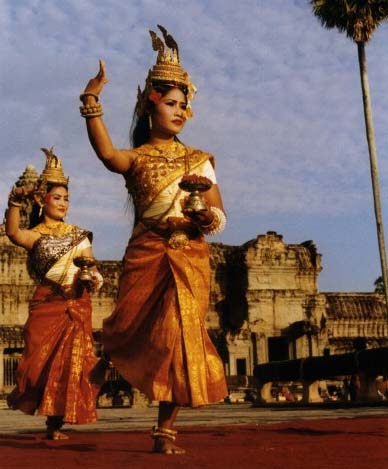 |
| Apsara Dancer, Angkor Wat |
History of Cambodia
The Khmer or Angkor Civilization came into existence during the period from 802 to 1431 A.D. and stretched as far as the modern Thailand-Burma Border in the West and Wat Phou of Laos in the North during its peak.
Its emergence lies in the fact that the ancient Khmer rulers adopted a right political doctrine of its time, which enforce the unity among people. Moreover, they had developed an intelligent irrigation system to control the water of the great Mekong River for agricultures, which enhanced its prosperity. The Khmer Civilization had long been perished over 5 centuries ago, but it left outstanding monuments such as the great Khmer temples of Angkor Wat and Bayon and numerous unique sculptures like Apsara.
Angkor Wat (Siem Reap, Cambodia)
Giant Bayon faces dwarf a monk and a foreign tourist (Photo by Ko Ko Aung)
Mixed among the spread of paddy fields and plants Angkorian era temples and monuments - signs of architecture, arts, cultures, religions and civilization as well as inter state relationship of the bygone past - are ones of Cambodia's most visited tourist spots.
Influenced by various cultures and religions such as Indian, Khmer, Hindu and Buddhism these temple complexes were built roughly between 9th and 13th century AD. Most structures are in the state of ruins and under some kinds of restoration; and are one of UNESCO's World Heritage Sites.
Subscribe to:
Posts (Atom)


